

AI SEO and Answer Engine Optimisation
AI SEO and Answer Engine Optimisation. Be Understood Before You Are Recommended.
AI SEO and answer engine optimisation (AEO) makes a business easier for AI search experiences such as Google AI Overviews, ChatGPT Search and Microsoft Copilot to find, understand and cite, using crawlable pages, clear entity information and evidence-backed content.
AI search experiences still depend on pages they can crawl, index and trust, so this work builds on SEO rather than replacing it. No one can guarantee that an AI system will cite a particular business; Madvert Labs improves the conditions that make an accurate citation possible, as part of Client Acquisition. Madvert Labs offers AI SEO and AEO services from Karachi to businesses in Pakistan and internationally.
Who this is for
Who AI SEO and AEO is for
A good fit
- Brands that want to show up when buyers ask ChatGPT, Gemini or Google's AI answers for recommendations.
- Businesses whose company description, services or founder details are inconsistent across the website and profiles.
- Companies with real expertise and case studies buried in PDFs, images or pages search engines cannot read.
- Teams that already have SEO fundamentals and want to extend them to AI search.
Probably not the right fit
- Anyone looking for a guaranteed mention in ChatGPT or Google AI answers. That guarantee does not exist.
- Sites that cannot yet be crawled or indexed properly. Technical SEO comes first.
The problem
How AI search changes what buyers see
Buyers increasingly ask a question and read a generated answer before visiting any website. Google shows AI Overviews and AI Mode alongside its results, ChatGPT Search answers with links to its sources, and Microsoft Copilot draws on Bing's index.
These systems can only use what they can find and understand. A business whose services are described differently on every page, whose proof sits in images without text, or whose pages block crawlers gives AI systems little to work with, and the answer names someone else.
Google states that the same SEO best practices apply to its AI features and that no special file or markup is required to appear in them. AI SEO at Madvert Labs therefore focuses on fundamentals done thoroughly, not tricks.
How it works
How AI search visibility work is done
Step 1: Baseline
Ask the questions buyers ask in Google, ChatGPT and Copilot, and record which businesses and sources are named. This is a snapshot, not a ranking, because AI answers vary between sessions and users.
Step 2: Crawl access
Check robots.txt, server responses and rendering so search and AI crawlers can reach important pages, and make sure key text is in the HTML rather than only in scripts or images.
Step 3: Entity clarity
Describe the business, its services, its founder and its locations the same way across the website, structured data and official profiles, so systems can connect the facts.
Step 4: Evidence-backed content
Turn real expertise into clear pages: direct definitions, how the service works, honest answers to common questions and case studies with real figures in readable text.
Step 5: Structured data
Add Organization, Service, Article, FAQ and breadcrumb markup only where it describes content that is visible on the page.
Step 6: Mentions and measurement
Support genuine coverage and accurate profiles, track visits from AI search in analytics, and repeat the baseline questions over time.
Comparison
Where AI search experiences find their sources
Each provider works differently, and each changes its systems often. Madvert Labs checks the current official documentation rather than relying on assumptions.
| AI search experience | What it draws on | What a business can influence |
|---|---|---|
| Google AI Overviews and AI Mode | Google's search index. A page must be indexed and eligible to appear with a snippet. | Indexing, helpful content, page experience and structured data that matches visible content. |
| ChatGPT Search | Web search results, including pages OpenAI's search crawler (OAI-SearchBot) is allowed to access. | Allowing OAI-SearchBot in robots.txt, server-rendered text and clear, quotable pages. |
| Microsoft Copilot | Bing's index and web results. | Bing Webmaster Tools, sitemaps, IndexNow and accurate, crawlable content. |
| Third-party sources | Publications, reviews, directories and profiles that mention the business. | Consistent business information and genuine coverage. Never fabricated reviews. |
Scope
What is included in AI SEO and AEO
Included
- AI visibility baseline across Google, ChatGPT and Copilot
- Crawler access review, including robots.txt rules for search and AI crawlers
- Checks that key content is server-rendered and readable
- Entity and brand information audit across the site and official profiles
- Definition-led service pages and genuine FAQs
- Structured data aligned with visible content
- Case study and evidence pages in readable text
- Analytics setup to identify visits from AI search referrals
Not included
- Guaranteed citations, mentions or recommendations in any AI system.
- Hidden text, content shown only to bots, or instructions written to manipulate AI models.
- Fake reviews, invented statistics or fabricated expert quotes.
- Mass-produced AI content created only to target questions.
Examples
Examples of AI SEO deliverables
Definition blocks
A short, self-contained answer at the top of each service page that names the service and says what it is and who it is for, in text any system can quote accurately.
Readable case studies
Results that only existed inside a PDF or an image republished as text with the real figures, the context and the source document linked.
An entity sheet
One agreed description of the company, its services and its founder, used across the website, the schema and official profiles.
An AI answer log
A repeatable list of buyer questions, checked periodically across AI search tools, recording the sources each answer cites.
Common questions
AI SEO and AEO: common questions
What is answer engine optimisation (AEO)?
Answer engine optimisation (AEO) is the practice of making a business's information easy for search and AI systems to find, understand and quote when they answer questions. In practice it means crawlable pages, clear and consistent facts about the business, direct answers to real questions and visible evidence.
Can you guarantee our business will appear in ChatGPT or Google AI Overviews?
No. Google, OpenAI and Microsoft decide what their systems show, answers change between users and sessions, and none of them sells placement in organic AI answers. Madvert Labs improves the factors those systems rely on and reports honestly on what changes.
Do we need an llms.txt file or special AI markup?
Google says no special files or markup are needed to appear in its AI features. Madvert Labs does not treat an llms.txt file as a visibility lever; crawlable pages, clear content and accurate structured data matter far more.
Is AI SEO different from normal SEO?
AI SEO builds on SEO. The foundations are the same: crawling, indexing, helpful content and trust. AI SEO puts more weight on entity clarity, direct self-contained answers, consistent business information across the web and evidence that can be quoted.
How do you measure AI search visibility?
Through a repeatable set of buyer questions checked across AI tools, referral visits from AI search in analytics, and data from Google Search Console and Bing Webmaster Tools. These measures are directional, because AI answers are not a fixed ranking.
Related resources
Free resources from the Madvert Vault
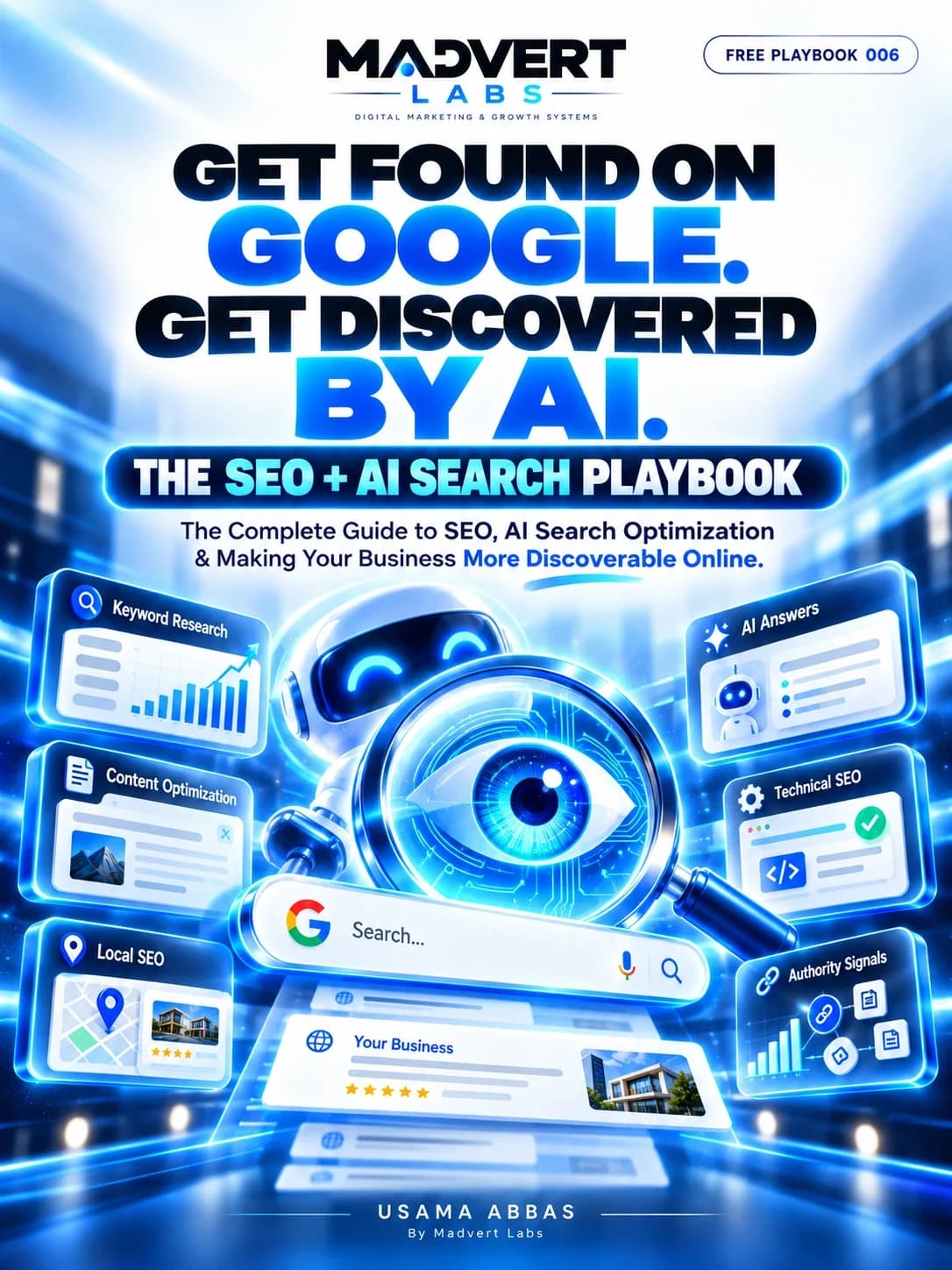 SEO & AI
Get Found on Google. Get Discovered by AI.
The complete guide to SEO, AI search optimisation and making your business more discoverable online.
Get the Playbook- Checklist
Brand Perception Checklist
Madvert Vault
BrandBrand Perception Checklist
Find what makes your business look smaller online than it really is.
See the Checklist
Make the Business Easy for AI Search to Understand.
Keep exploring
More on sEO, AI SEO and answer engine optimisation
Next Step
Partner Up with MADVERT Labs.
- No generic pitch.
- No pressure.
- Just a serious conversation about growth.